

Why is my membership model so hard to change?
Dues, member types and benefits drift for years. Then a revenue gap or a dip in members forces a decision, and nobody can say what a change will do to renewals, joins or the budget.

Dues are set by habit
Rates rise by guesswork or not at all, and inflation quietly cuts real revenue.

Member types no longer fit
Member types built years ago miss early-career members.

Nobody can test a change first
Leaders debate options without numbers on members, revenue or payback.
Ricochet shows you the trade-offs in numbers before you decide.
You see the trade-offs in numbers before you decide. A real financial model shows members, revenue and payback move as you change renewal, recruitment and dues. Benchmarks come from a research library, not opinion, and every engagement ends with a roadmap for the order and timing of each change.
A real financial model
Change renewal, recruitment and dues, then watch members, revenue and payback move.
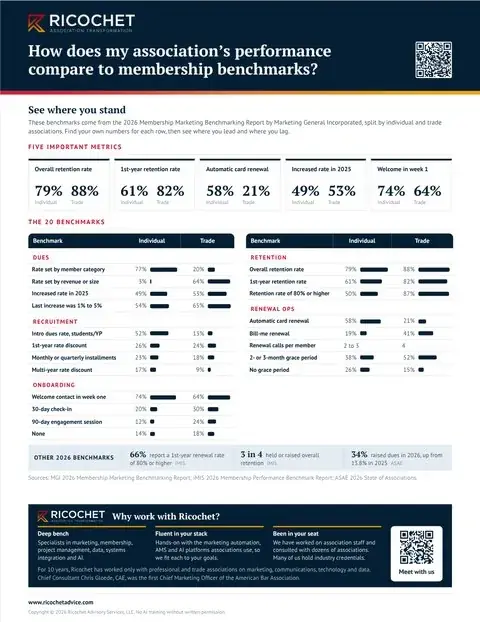
Benchmarks from a research library
Peer and dues comparisons start from evidence, not opinion.
More scenarios, faster
Compare more options in less time, before you commit to one.
A roadmap, not a report
Every engagement ends with the order and timing of each change.



What do I get from membership modeling?
A working financial model of your association, and a roadmap for the changes it points to. You start with an audit of your current model against industry benchmarks, test member type, tier and dues options, and see expected, good and poor cases side by side before you commit.
- A clear starting pointAn audit of your current model, with industry benchmarks.
- Options worth testingMember type, tier and dues options built for your association.
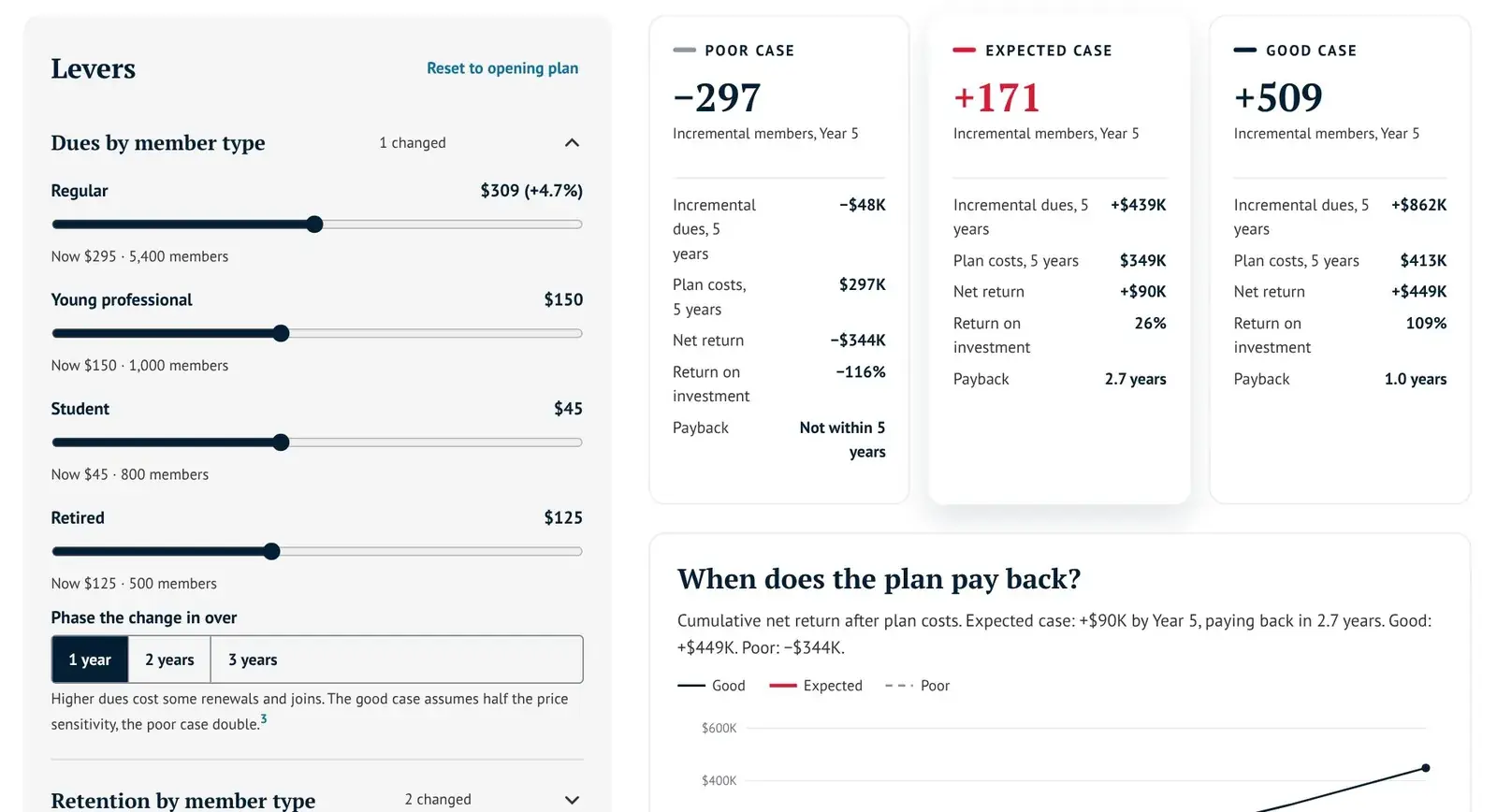
- A model you can workChange a lever and see the expected, good and poor cases side by side.
- A plan staff can runThe order and timing of every change, written down.
Which levers can grow membership and dues revenue?
Three main levers shape every membership model: benefit value, dues rates, and member types and tiers. Supporting levers, such as how long members take to embrace a change, fine-tune the forecast. Set them together and the model shows good, expected and poor outcomes for members and revenue.

- Lever 1
Benefit value
Which benefits members value, and which cost more than they return.
- Lever 2
Dues rates
The fees and discounts you offer, and the yearly increase practice that keeps pace with inflation.
- Lever 3
Types and tiers
Types charge different rates for the same benefits. Tiers charge different rates for different benefits.
- The result
Forecast
Set the main and supporting levers, and the model shows the good, expected and poor outcomes for members and revenue.




- Market uptakeHow long members take to understand and embrace a change. Steady, consistent communication shortens it.
- Price sensitivityHow sharply renewals and joins drop as dues rise. The model tests every rate against it.
- Recruitment offersIntro rates for students and young professionals.
- Renewal practiceAuto-renew, billing timing and grace periods.
Let’s talk about your association
Bring your toughest question. We’ll help you find the next step.
Let’s talk