

Why do most member surveys get filed?
Your members know what they need, but many surveys are written from the organization’s point of view. The questions are not built for action, the results arrive as averages, and the report ends without a next step.

Questions written from the inside out
Too long, with too few responses per segment to trust.

Reruns repeat old blind spots
The same questions come back, and nothing new gets tested.

Averages hide what matters
One topline number hides the segments, and nothing says what to do next.
What makes a Ricochet member survey different?
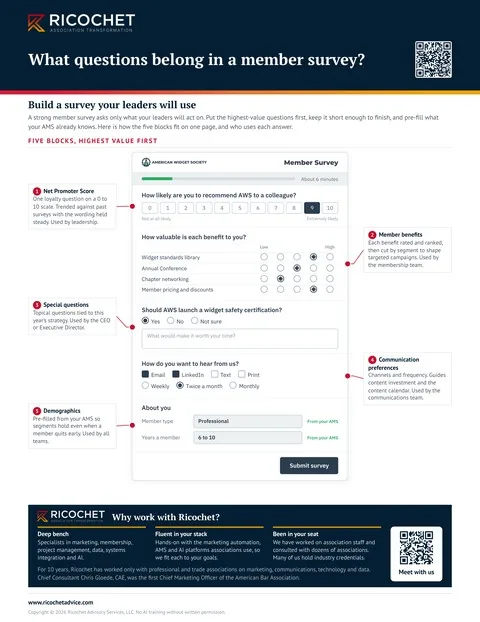
Ricochet member research gives you numbers your leaders can trust, cut the way they think, with a next step attached to each one. Every score carries its margin of error, members rank each benefit so you know what to feature for each segment, and every finding comes with a recommendation.
Segments, then slices
Every top-line number is cut by the segments your leaders care about.
Statistical confidence on everything
Every score is reported with its margin of error.
Benefits ranked by segment
Members rank each benefit, so you know what to feature for each segment.
Findings ship with action
Every finding comes with a recommendation your team can act on.

What happens in a member survey project?
A member survey project runs in four phases, each one feeding the next. We agree on what the research must answer, learn what your association already knows, build and field the survey, then turn every response into findings and recommendations your leaders can act on.

Administration
We agree on what the research needs to answer and how the project will run.
Discovery
We learn what your association already knows, so the survey asks what it does not.
Fieldwork
We build and test the survey, then keep responses coming while it is in the field.
Recommendations
We turn every response into findings and recommendations your leaders can act on.
Let’s talk about your association
Bring your toughest question. We’ll help you find the next step.
Let’s talk