

Which levers can grow membership and dues revenue?
Three levers significantly shape every membership model, and together they drive the forecast.

-
 Lever 1
Benefit value
Which benefits members value, and which cost more than they return.
-
 Lever 2
Dues rates
The fees and discounts available to your members, and the annual increase practices that manage against inflation.
-
 Lever 3
Types and tiers
Types charge different rates for the same benefits. Tiers charge different rates for different benefits.
-
 The result
Forecast
Set the three levers, and the model shows the good, expected and poor outcomes for members and revenue.
What makes Ricochet membership modeling reliable?
You see the trade-offs in numbers before you decide.
-
A real financial model
An interactive model, not a simple projection. Leaders adjust renewal rates, recruitment pace and dues, then watch members, revenue and payback change.
-
Benchmarks from a research library
Peer and dues comparisons draw on Ricochet's extensive library of association research benchmark reports, so options start from evidence, not opinion.
-
More scenarios, faster
Ricochet uses a proprietary tool to create interactive financial and performance scenarios in less time, so you can compare more options. Try the demo
-
A roadmap, not a report
Every engagement ends in a transformation roadmap and implementation support, not a report on a shelf.
What happens if my association changes dues, retention or tiers?
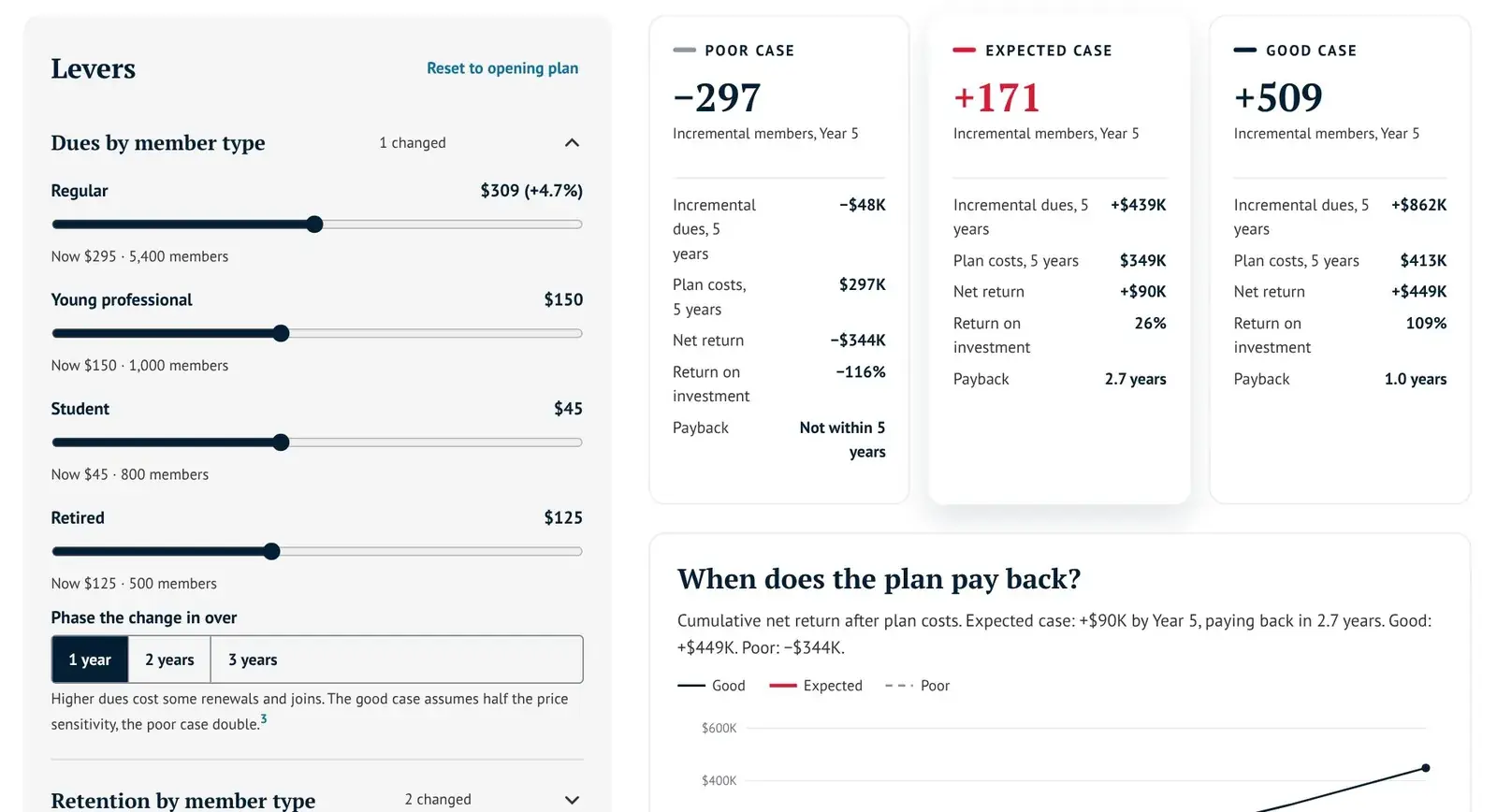
Move the levers in our American Widget Society demo. The model forecasts members, dues revenue, return and payback for five years, in a good, an expected and a poor case. Try the demo.
The association and its data are fictional.
What do I get from membership modeling?
A working financial model of your association, and help carrying out the changes it points to.
- A clear starting pointAn audit of your current model, with peer and dues benchmarks.
- Options worth testingMember type, tier and dues options built for your association.
- A model you can workChange a lever and see the expected, good and poor cases side by side.
- Help making the changeA transformation roadmap, with Ricochet support through implementation.
Member survey findings sharpen the model in Member Research, and new member types often need system changes planned in Tech and AI Roadmaps.
What associations ask about membership modeling
Do we need member research first?
No. Modeling starts with an audit of your current model and data. Member survey findings make the model sharper when you have them.
What is the difference between member types and tiers?
Member types charge different rates for substantially the same benefits. In individual membership associations, types usually follow career stage, such as student, early career and retired. In trade associations, they usually follow a member company's annual revenue. Tiers charge different rates for substantially different benefits.
What is a firm or group membership model?
One organization pays for a group of its people to join, instead of each person joining alone. We model how a group rate affects members, revenue and renewals.
How do associations grow membership?
By pulling three levers together: the benefits members value, dues rates set against peers, and member types or tiers that fit each audience. Recruitment offers, such as intro rates for students and young professionals, help too. Ricochet models each option in a working financial model, so you see the effect on members and revenue before you commit.
What causes member retention to drop?
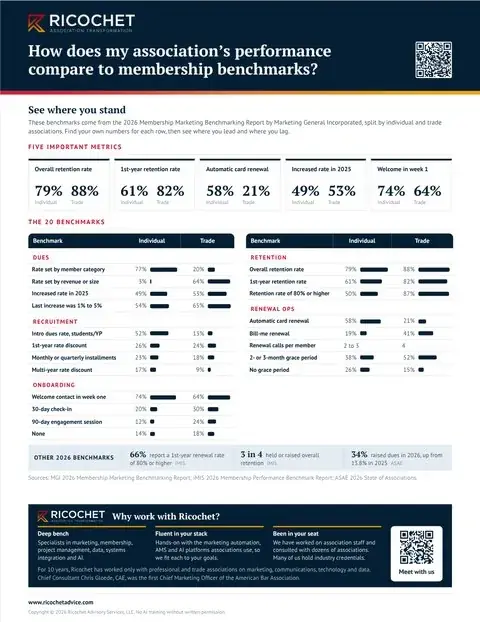
First-year members are usually the weak spot. In the 2026 MGI Membership Marketing Benchmarking Report, first-year retention averages 61% at individual associations, against 79% overall. Weak onboarding, dues out of line with perceived value and benefits that miss key segments all add to it. A membership model shows which lever moves your renewal rate most.
How often should an association raise dues?
Many associations raise dues a little every year, tied to an inflation measure such as the Consumer Price Index. Larger increases have no set schedule. The right time is when the model shows an increase will grow revenue without losing more members than you can afford.
How do associations raise dues without losing members?
Model the increase before you decide. About half of associations raised dues in 2025: 49% of individual and 53% of trade associations, according to the 2026 MGI Membership Marketing Benchmarking Report. Ricochet models renewal and recruitment at each rate, so you see how many members a rate could cost and how much revenue it adds.
How do you forecast the impact of a dues change?
In an interactive scenario dashboard. Leaders adjust renewal rates, recruitment pace and dues, and see members, revenue and payback change.
Let's talk about your association
Bring your toughest question. We'll help you find the next step.
Meet with us