

What happens in a member survey project?
Four phases, each one feeding the next, from the research objectives to the last recommendation.

Administration
A kickoff workshop sets the research objectives, the segments and the roles. Weekly status meetings keep it on track.
Discovery
We review your past research and talk with staff and stakeholders, so the survey asks what you actually need to know.
Fieldwork
We write, design and program the survey, then send the invitations and reminders that drive response.
Recommendations
We analyze every response and deliver findings, each with a recommendation your team can act on.
What makes a Ricochet member survey different?
Numbers your board can trust, cut the way your board thinks, with a next step attached to each one.
Segments, then slices
Every top-line number is cut by the segments your board worries about. Double and triple slices are standard, not an add-on, so one survey yields dozens of findings instead of one average.
Statistical confidence on everything
We report the confidence interval alongside every score. A 4 and a 3 are the same number until the interval says otherwise, so you never react to noise in a small subgroup.
Every comment, coded
AI makes open-ended answers analyzable at scale. Every comment is coded into themes, so hundreds of write-ins become a finding instead of a few quotes.
Findings ship with action
Every finding comes with a recommendation, sorted into easy wins your team can move on now and long-term initiatives that need budget or buy-in.
What do I get at the end of a member survey?
A formal findings report your leaders can act on, with a recommendation for every finding.
- A survey built for your membersThe survey instrument, written and designed for you.
- Fielding handled for youProgramming, invitations and reminders, managed by Ricochet.
- Every response analyzedEach result cut by segment and reported with its margin of error.
- Recommendations you can act onA findings and recommendations report, plus the full dataset.
Survey findings often lead to the next step. Findings on dues feed Membership Modeling, and findings on perception feed the Marketing Studio.
Should I run a survey, focus groups or interviews?
A survey is quantitative: it measures how many members hold a view. A focus group is qualitative: it explores why. Most associations start with a survey.
| Member survey | Focus groups | AI-assisted interviews | |
|---|---|---|---|
| Purpose | Validate. Confirm what you believe, with the statistical confidence to set direction. | Explore. Open, unstructured discussion that shapes ideas and feeds your decisions. | Both. Open-ended exploration, at a scale that supports confidence. |
| Answers | How many members hold a view | Why members feel the way they do | How many, and why |
| Who takes part | Your whole membership (including prospects and past members.) | 6 to 12 participants per group | Hundreds of participants, each on their own schedule |
| Statistically significant? | Yes, reported by segment with confidence intervals | No. Groups are too small. | Yes, with enough participants |
What associations ask about member surveys
Do we need a survey or focus groups?
A survey validates how many members hold a view with statistical confidence, while focus groups explore why members feel that way through open discussion. Most associations start with a survey. Use survey findings to confirm what you believe and set direction; use focus groups to shape ideas before deciding what to investigate or do next.
What does a member survey cover?
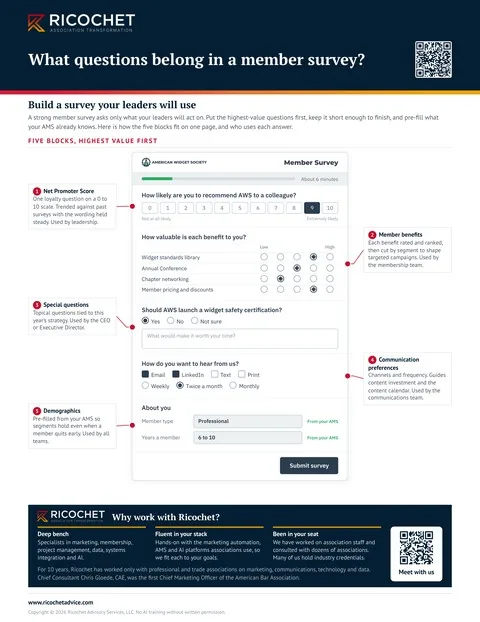
A member survey covers questions ordered by what each one is worth, including a loyalty score benchmarked against the industry and member benefits ranked by segment. It can also ask about your current strategic initiatives and communication preferences. Demographic questions can also be included, and Ricochet reviews past research to refine the questions.
Can you survey lapsed members and prospects?
Yes, Ricochet can survey lapsed members and prospects through nonmember surveys, helping your association learn why people leave and what would bring them in. Including these audiences gives you feedback beyond current members, so you can better understand barriers to returning or joining and use those findings to inform next steps.
What do we get at the end?
At the end, you get a formal findings report with a recommendation for every finding, split into easy wins and long-term initiatives, plus the full dataset for your permanent records. Ricochet analyzes every response, reports results by segment with margins of error, and connects findings to actions your team can take now or plan for longer term.
How many responses do we need?
You need enough responses for each segment you want to compare. Ricochet reports confidence intervals alongside scores, helping you see which differences are real and which are noise, including in small subgroups. Because the analysis is cut by the segments your board cares about, response needs depend on which comparisons your association wants to make.
What do members actually value?
Ask them, then cut the answer by segment. A member survey has members rate and rank each benefit, then compares the results across member types, career stages and regions. A benefit that ranks low overall can matter most to one segment. Ricochet reports each result with its margin of error, so you act on real differences, not noise.
How do we get a real response rate on a member survey?
Keep it short enough to finish. Put the highest-value questions first, and pre-fill what your AMS already knows, such as member type and years of membership. Then send a planned series of invitations and reminders. Ricochet writes, programs and fields the survey, and drives response through those reminders.
How do we learn how members prefer to be contacted?
Ask about channel and frequency in your member survey. A communication preferences block asks which channels members want, such as email, LinkedIn, text or print, and how often they want to hear from you. The results guide your content calendar and where you invest, and they can feed a preferences center where members choose for themselves.
Let’s talk about your association
Bring your toughest question. We’ll help you find the next step.
Let’s talk